GM2400-Portable stench
GM2400-Portable stench

The GM2400 portable malodorous gas monitor is a specialized device designed for monitoring and analyzing the concentrations of specific malodorous gases in the air, as well as for assessing the overall intensity of such odors. Its main value lies in the ability to transform the subjective perception of “malodors” into objective, quantifiable data, thereby facilitating the identification of the sources of these odors, their control, and the assessment of compliance with relevant regulations.




功能特点(所有型号) | Product Features
- Simultaneously detects 10 parameters, including OU, TVOC, ammonia, hydrogen sulfide, styrene, trimethylamine, methanethiol, methanethioether, dimethyldisulfide, and carbon disulfide.
- Broad-spectrum sensor array, equipped with 11 types of sensors (Invention Patent: ZL202411341461.5)
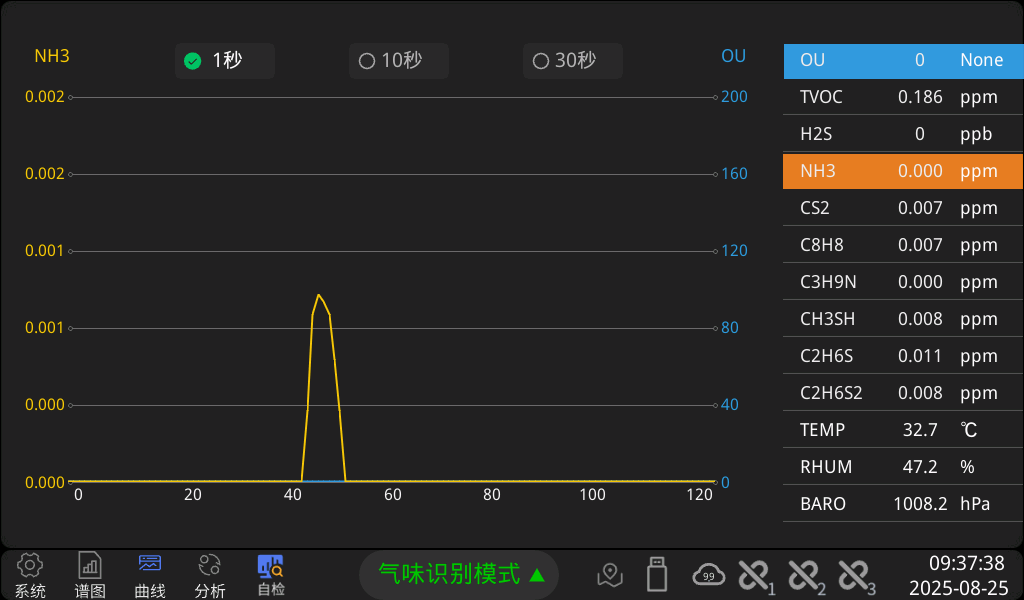
- Real-time concentration curves, alarms for exceeding regulatory limits, and odor traceability maps.
- Independent air chambers; coated with PTFE to prevent gas adsorption.
- Multiple working modes are available; independent algorithm optimizations are implemented to adapt to different on-site conditions.
- Fixed antenna; onboard eSIM communication card; industrial-grade card, mounted using soldering technology.
技术原理 | Technique Principle

A broadband sensor array is constructed using PID, MOS, and EC technologies. By analyzing the detected gases from various dimensions, relatively unique multi-dimensional spectra can be obtained, enabling accurate measurements of the gases. This approach effectively eliminates the problem of cross-interference between sensors.
- Sensing technology: Combination of multiple types of sensors (MOS/EC/PID); optimization of the array layout (including the design of microfluidic channels and temperature gradient control); development of adaptive, dynamic arrays.
- Signal processing: Detection technologies such as multi-modal signal acquisition, digitization of weak signals, and simultaneous measurement of environmental parameters such as temperature, humidity, and pressure. Intelligent preprocessing algorithms, wavelet transform-based noise reduction techniques, baseline drift correction algorithms, and dynamic compensation models are also utilized.
- Pattern recognition: Extraction of features in the time-frequency domain, exploration of nonlinear features (through chaos analysis and fractal dimension calculations), as well as automatic feature extraction using deep learning techniques (such as the creation of feature maps).
产品性能 | Product Performance

- By obtaining relatively unique multi-dimensional spectra from different dimensions, precise measurements of gases can be carried out, thereby eliminating the problem of cross-interference between sensors.
- The sensor array measurement method allows for mutual compensation, thereby eliminating the need for frequent calibrations and addressing the issue of sensor “poisoning” (i.e., when a single sensor becomes inaccurate due to external influences).
- The sensor module is capable of measuring more than 100 different gases. In addition, users can customize the gas database according to their needs, thus eliminating the issue of high system complexity when dealing with multiple gas parameters.
- The combination of photoions and metal oxides reduces the response time to 16 seconds.
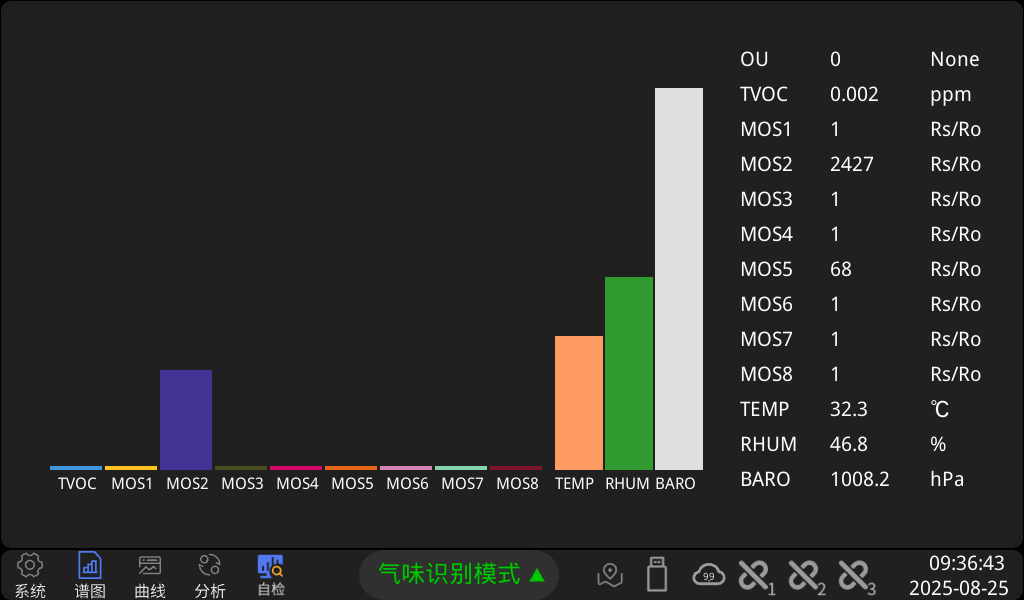
功能界面 | Functional Interface
应用场景 | Application Scenarios
| Industrial production The industrial sector is one of the main sources of foul-smelling pollution, involving industries such as chemicals, food processing, and coating. Monitoring devices are primarily used to control the emission of foul-smelling gases during production, storage, and disposal processes, in order to prevent violations of regulations that could result in fines or complaints from nearby residents. | |
| Wastewater treatment In urban sewage treatment plants and industrial park sewage treatment facilities, hydrogen sulfide, ammonia, and volatile organic acids (such as acetic acid) generated during the anaerobic decomposition of sewage are monitored in real time. The concentration of these odorous substances during the treatment process is also continuously monitored; when the levels exceed the allowable limits, the spray deodorization system is activated to minimize the impact on the surrounding environment. | |
| Livestock and poultry farming Monitor the gases generated during the decomposition of livestock and poultry manure, such as ammonia, hydrogen sulfide, trimethylamine, and indole (the main components responsible for the unpleasant odor of manure). This helps prevent the spread of these odors to the surrounding environment. Additionally, it facilitates the adjustment of the frequency of manure removal (e.g., ensuring timely disposal) and the sealing process of biogas digesters, thereby avoiding the occurrence of non-point source pollution. | |
| Emergency leakage In the event of sudden occurrences of foul odors, such as leaks from storage tanks in chemical plants, rollovers of vehicles transporting hazardous substances (resulting in the leakage of ammonia, sulfides, etc.), or ruptures in pipelines at sewage treatment plants, it is essential to quickly monitor the concentration of the foul odor in the affected area as well as its spread range. This information is crucial for guiding emergency response teams in determining the appropriate “evacuation radius” and assessing the extent of the pollution – for example, to decide whether it is necessary to activate a tiered emergency response system. |


|