PM1020-Road dust load
PM1020-Road dust load

The PM1020 Road Dust Load Mobile Monitoring Device is a portable monitoring system integrated into vehicles. By dynamically collecting and analyzing the concentration of particulate matter in the air on roads and in the surrounding environment, it enables real-time, quantitative assessments of the dust load on road surfaces.



功能特点 | Product Features
- Laser scattering sensor; high-power laser; capable of identifying particle sizes.
- Real-time data detection and transmission; data is uploaded within seconds, allowing for uniform monitoring of each section of the road.
- The display of road dust levels on the geographic information platform provides a visual representation of the dust pollution on the streets.
工作原理 | Operating Principle
The dust is generated as a result of the air currents caused by the movement of vehicles; these air currents lift the loose particles on the road surface into the air. A sampling port is installed behind the right rear wheel of the vehicle, and equal-speed sampling technology is used to ensure that no small particles are missed. A background sampling tube is installed on the roof of the vehicle to monitor the concentration of particles in the ambient air. By comparing the dust levels on the road surface with the background values, external interference can be effectively eliminated.
Particulate matter measurement technology: The laser scattering method enables simultaneous measurement of the concentrations of PM2.5, PM10, and TSP (Total Suspended Particulate Matter).
Multi-dimensional data integration: By integrating the Beidou positioning module (with an accuracy of ≤5 meters), it is possible to establish a spatial-temporal correlation between the data. Real-time trajectories, as well as pollution heat maps, are used to overlay information regarding dust accumulation levels with road conditions, construction activities, and other relevant factors, thereby creating a “digital map”.
系统组成 | System Composition

功能界面 | Functional Interface

Front-end device user interface
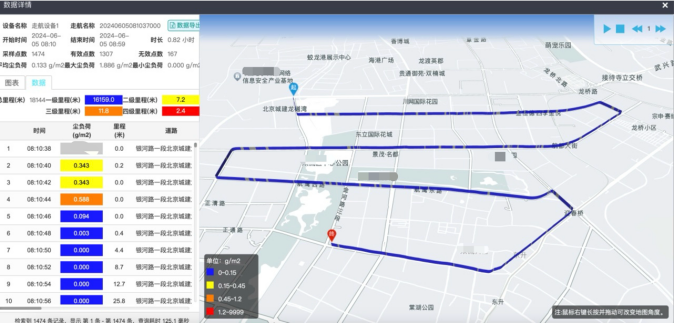
Cloud platform interface
|