AQM200-Environmental Microsite
AQM200-Environmental Microsite

The AQM200 micro air quality monitoring system is a compact, cost-effective device with flexible deployment options. It is primarily used to compensate for the monitoring gaps associated with traditional, large-scale air quality monitoring stations, thereby enabling more detailed and comprehensive monitoring of air quality on a regional scale.




功能特点 | Product Features
- It supports the monitoring of PM1.0, PM2.5, PM10, and TSP. The measurement is based on the laser scattering principle, and industrial-grade semiconductor lasers are used; the accuracy of the measurements is comparable to that of the beta-ray method.
- Supports the management of the sensor’s lifecycle, enabling effective monitoring of sensor degradation and ensuring more accurate measurements. (Invention Patent: ZL202411471829.X)
- The number of monitoring parameters can be extended to over 20; it is also possible to detect up to 10 gases simultaneously.
- It uses high-performance, long-lasting brushless motor air pumps; under standard operating conditions, their service life is ≥2 years.
- Welded SIM card, fixed antenna, and industrial-grade design – all these features help reduce the risk of malfunctions and ensure that the device can operate effectively in various working conditions.
应用场景 | Application Scenarios
| Urban environmental monitoring The micro-air stations arranged in a grid pattern within the city continuously monitor the air quality in various areas. They provide valuable data to the urban environmental management departments, helping them to understand the current air quality situation and take timely measures to improve the environment. | |
| Natural environment monitoring Micro-air stations are installed in natural environments such as mountainous areas, lakes, and forests to monitor the air quality in these areas and assess the impact of human activities on the natural environment. | |
| Public place monitoring Installing micro-air quality monitoring stations in public places such as schools, hospitals, and office buildings helps to assess the impact of air quality on people’s health. These stations provide valuable data for relevant authorities, thereby ensuring the quality of the indoor environment in these public areas. | |
 | Environmental monitoring in industrial areas Micro-air stations are installed in industrial areas to monitor the impact of industrial waste gas emissions on the air quality in the surrounding areas. These stations provide timely warnings in case of excessive waste gas emissions, thus protecting the health of the local residents. |



产品性能 | Product Performance

The measurement drift of electrochemical sensors is reduced by using a calibration method that combines sensitivity, baseline values, and the k-value.
The sensor drift problem can be resolved by following the methods outlined below:
- Each sensor is individually calibrated before being put into use.
- Calibrate the baseline values regularly based on usage patterns and atmospheric conditions.
- The k-value is calculated based on the concentration of the standard gas and the current measured concentration, and then used for correction.
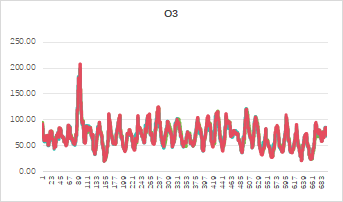
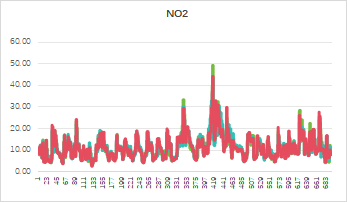
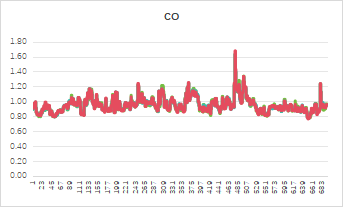
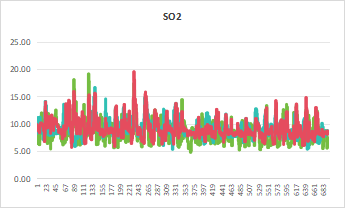
Monitoring data (hourly data for three devices over a one-month period):


|